
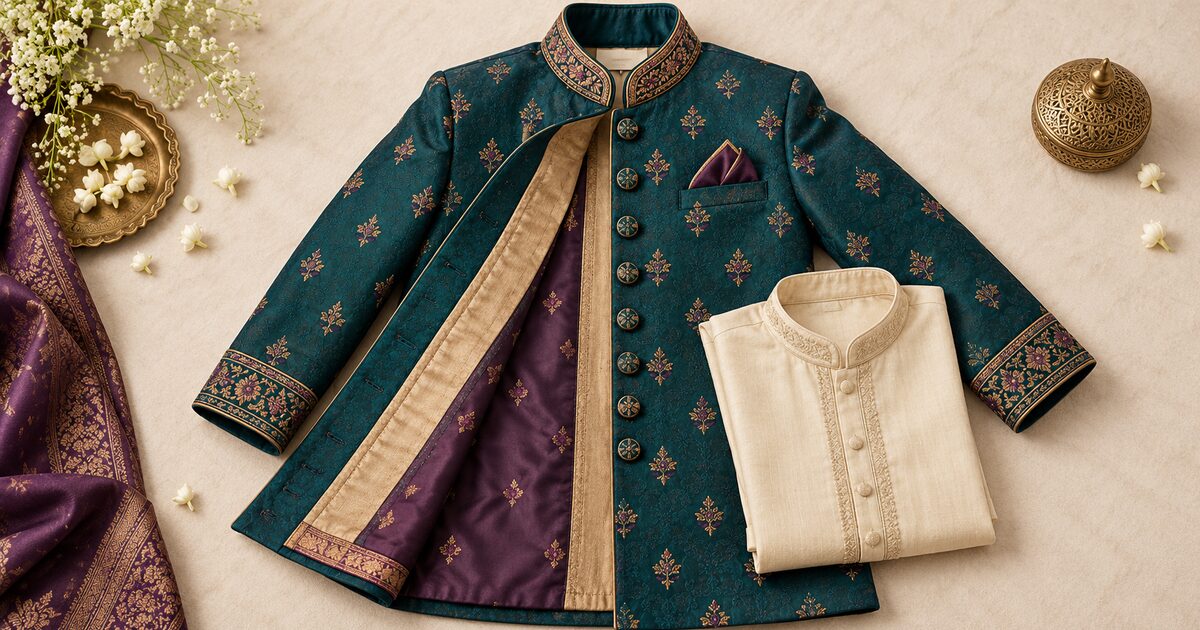
Boys’ sherwani buying guide
Buying a Sherwani for Boys: Construction and Layering
A sherwani can look impressive from the front while hiding stiff layers, weak buttons or an unfinished interior. Use this practical inspection method to understand how the garment is built before buying.
A boys’ sherwani is usually a layered garment rather than a single piece of fabric. The visible shell may be supported by lining, facing, interfacing, embroidery backing or several of these. Underneath it, the set may include a kurta, vest or another inner piece. Product photographs rarely show how these parts meet, so a useful buying check looks at construction in a fixed order.
This guide evaluates materials, internal build, button access, layering and care information. It does not give body-measurement instructions, recommend a size or explain wedding dress codes.
Understand what gives the sherwani its shape
Structure is the support that helps the collar, front opening and long panels keep their intended form. It may come from the outer weave itself or from hidden materials between the shell and lining. The goal is not maximum stiffness. The useful question is whether the structure is controlled and consistent across the garment.
- 1Outer shellThe visible woven, printed, textured or embroidered layer.
- 2Front supportFacing or interfacing that stabilises the opening and button area.
- 3Collar supportHidden reinforcement that helps the collar hold its form.
- 4Inner liningThe layer that covers internal construction and helps the coat slide over clothing.
Hang the sherwani from a suitable hanger, close its main fastening and view it from the front and side. The two front edges should follow the intended line without one side twisting forward. Look for bubbling around the opening, sharp creases that do not release, or a collar that collapses on one side. These signs do not identify a specific manufacturing fault on their own, but they justify a closer look inside.
Supported
The front keeps its shape, the collar stands evenly and the layers move together without obvious ridges.
Overbuilt
The garment feels board-like, folds resist movement or a hard internal edge can be felt through the shell.
Unstable
The opening ripples, panels twist or concentrated decoration pulls the surrounding fabric out of shape.
Patterned fabric adds another useful clue. At the centre front, pockets and other prominent joins, check whether repeated motifs meet in a deliberate way. Perfect matching is not possible or intended in every design, especially with handwork, but abrupt breaks can reveal where panels or trims are pulling against one another.
Inspect the lining as a working layer
A lining should cover the intended internal construction without creating a second, smaller shell. Open the sherwani fully and check the neckline, arm openings, front facing, side seams and lower edge. The lining should lie inside the coat rather than rolling outward or forming diagonal tension lines.
| Inspection point | What to look for | Why it matters |
|---|---|---|
| Front facing | Lining joined cleanly beside the opening, without catching the buttonholes or fastening hardware. | The opening needs to work repeatedly without pulling an inner layer into it. |
| Underarm area | No missed seam, trapped fold, exposed rough edge or concentrated bulk. | Several seams meet here, making poor finishing easier to feel and harder to repair neatly. |
| Lower lining | A controlled hem or attachment that stays inside when the coat hangs naturally. | A lining that hangs below the shell or pulls it upward can spoil the outer line. |
| Decorated areas | Thread ends, backing and attachment points covered or otherwise kept away from the inner layer. | Loose internal work can snag a kurta or catch when the sherwani is put on. |
Fibre names do not predict comfort by themselves. A smooth synthetic lining and a cotton lining behave differently, but either can be poorly cut or badly joined. Ask what the lining is made from, then judge the construction you can actually see: surface, joins, bulk and how it moves with the outer shell.
Confirm the complete layering system
“Sherwani set” does not always describe the same components. One listing may include a coat and trousers; another may add a kurta, vest, stole or accessories. Write down what is included before judging how the outfit will work. A styled photograph may show pieces that are sold separately.
| Seller’s description | Detail to confirm | Useful evidence |
|---|---|---|
| Fully lined | Which panels and sleeves are lined, and whether the lining fibre is identified. | An inside-out photograph showing the front, back and sleeves. |
| Complete set | Every included garment and accessory, listed individually. | A flat-lay photograph of the exact pieces supplied. |
| Inner kurta included | Whether it is a full kurta, a sleeveless insert, a mock panel or another construction. | A separate front-and-back photograph of the inner piece. |
| Detachable layer | How it attaches, which hardware remains visible and whether it must be removed for care. | Close-ups of the attachment points in both positions. |
To test compatibility in a shop, use the actual inner garment intended for the outfit rather than substituting a very different layer. Open and close the sherwani normally, then observe whether the inner fabric catches at the front, bunches beneath the arm or appears unexpectedly through the opening. The purpose is to test how the supplied pieces interact, not to determine a body size.
For an online purchase, ask whether the product photographs show the exact set and whether any styling layer is excluded. Also confirm if the sherwani can be worn without a particular insert or vest; some designs rely on a mock front or shared fastening that is not obvious in a photograph.
Read care information before judging value
Embroidery, trims, lining, interfacing and detachable hardware can make the care method different from what the outer fabric alone suggests. Read the permanent label and any product-page instructions before purchase. If the set contains multiple garments, confirm whether one instruction applies to every piece.
ISO 3758:2023 defines a system of textile-care symbols and describes them as indicating the most severe treatments that do not cause irreversible damage during care. In the United States, the Federal Trade Commission’s Care Labeling Rule requires manufacturers and importers covered by the rule to attach care instructions to clothing. These references explain why care information matters; they do not make every online claim accurate or create one universal label format for every country.
- Match the instruction to the pieces.Identify whether the coat, kurta, trousers and removable trims share the same care method.
- Ask about detachable hardware.Confirm whether buttons, chains, brooches or other components must be removed and how to remove them safely.
- Clarify conflicting information.If the sewn label and product page disagree, request the correct instruction in writing before cleaning.
- Keep the record.Save the listing and seller’s reply until the garment has been inspected and the return decision is complete.
Request evidence that product photos usually omit
Generic questions invite generic answers. Ask the seller for specific views and name the feature you are trying to verify.
- Inside front and back.Ask for the full lining, facing and lower edge in clear light.
- Collar from both sides.Request the inside neckline, collar join and top fastening.
- Working opening.Ask for a short video showing the complete fastening sequence without the fabric being forced.
- Reverse of decoration.Request the internal view behind concentrated embroidery, buttons or applied trim.
- All set components.Ask for the exact included garments laid flat separately, not only a styled model image.
- Every label.Request readable photographs of fibre composition and care information for the sherwani and inner pieces.
On arrival, inspect the item before removing labels, cleaning it, steaming decoration or altering any seam. Compare the supplied pieces and construction with the listing and saved replies. Photograph a difference immediately and follow the seller’s return process where appropriate.
Boys’ sherwani construction checklist
Use this checklist in a shop or during the first indoor inspection after delivery.
Common questions
Is a heavier boys’ sherwani better quality?
No. Weight may come from the shell, embroidery, lining or internal support, but it does not prove that those layers are well joined. Examine panel alignment, collar support, lining behaviour, fastening security and care information instead of using weight as a quality score.
Does every sherwani need a full lining?
Construction varies by design. Ask which sections are lined and what the lining is intended to cover. The useful test is whether the internal finish is controlled and whether the lining performs its role without rolling outward, catching in fasteners or distorting the shell.
Why are some sherwani buttons only decorative?
A design may use visible buttons for appearance while a hidden zip, hooks or snaps operate the opening. Confirm the working mechanism before pulling any part. Decorative hardware should still be securely attached, and removable pieces should come with clear handling instructions.
What should be worn under a boys’ sherwani?
Use the component specified for that particular set, which may be a separate kurta, vest, insert or mock panel. Confirm what is included and how it attaches. This guide does not prescribe ceremonial styling; it helps you verify that the intended layers work together as constructed.
What if the care label covers only the sherwani coat?
Ask for separate care information for the kurta, trousers, detachable trim and any other included component. Materials and decoration can differ across a set, so one instruction should not automatically be assumed to cover every piece.
What evidence should I request from an online seller?
Request inside-out photographs, the collar from both sides, a video of the complete fastening sequence, the reverse of concentrated decoration, a flat lay of every included piece and readable images of all composition and care labels.
Sources and standards consulted
- International Organization for Standardization, ISO 4915:1991 — Textiles: Stitch types, classification and terminology. Accessed October 18, 2026.
- International Organization for Standardization, ISO 4916:1991 — Textiles: Seam types, classification and terminology. Accessed October 18, 2026.
- International Organization for Standardization, ISO 3758:2023 — Textiles: Care labelling code using symbols. Accessed October 18, 2026.
- U.S. Federal Trade Commission, Clothes Captioning: Complying with the Care Labeling Rule. Accessed October 18, 2026. Requirements vary by market; this source is identified as U.S. guidance.
Content review date: October 18, 2026.