
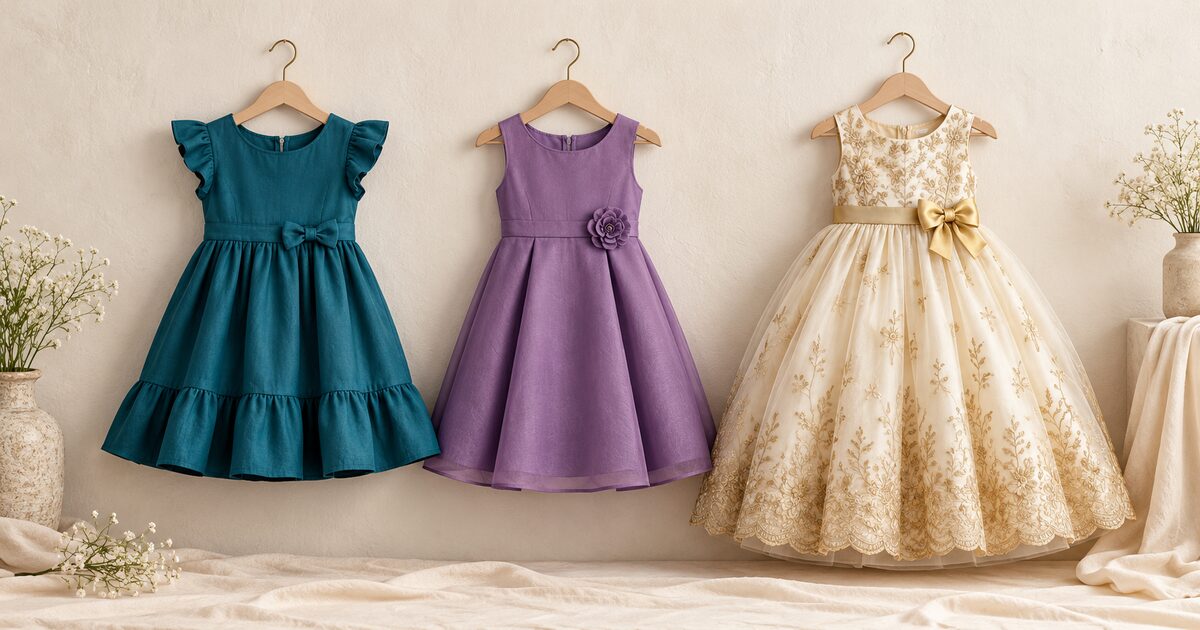
Girls’ clothing style guide
Frock, Dress or Gown: Choosing a Style for Girls
Product names change from shop to shop. Learn to compare the shape, opening, lining and intended activity so you can judge the actual garment instead of relying on its label.
Searching for frock vs dress vs gown for girls can produce confident definitions that do not match the next retailer you visit. The same fit-and-flare garment may be listed as a party frock, a girls’ dress or a gown. Regional usage, brand language and product marketing all affect the name.
The solution is not to find one universal label. It is to translate the listing into observable features. This guide compares one-piece frock, dress and gown styles. It does not cover lehenga construction, size charts, garment-length calculations or numerical fitting.
Treat the product name as a clue, not a specification
A product title tells you how a seller wants the garment to be found. It does not guarantee a particular skirt shape, level of formality, lining coverage or opening. Two shops can use different names for nearly the same garment, and one shop can apply the same name to several different constructions.
| Listing term | What it may suggest | What the term does not confirm |
|---|---|---|
| Frock | A child-focused everyday, festive or party style, often with a defined bodice and skirt. | The exact silhouette, opening, lining, fabric or activity suitability. |
| Dress | A broad category covering casual, school, party and formal one-piece garments. | Whether the design is simple, structured, layered or formal. |
| Gown | A style presented as formal, dramatic, fuller or more elaborately finished. | A specific hem position, number of layers or standard construction method. |
Start with the silhouette
Silhouette describes the garment’s overall outline. It is more useful than the product name because it shows where fullness is placed and how the outer layers are intended to hang. Use the following shapes as visual categories, not as rigid tailoring definitions.
A-line
An A-line shape widens progressively instead of changing suddenly at a waist seam. Inspect whether side seams hang evenly and whether pockets, ruffles or applied panels alter the clean outline. If the listing shows only a front view, ask for a side view so you can see whether the back has extra volume or a tie that changes the shape.
Fit-and-flare
This style usually joins a more defined upper section to a fuller skirt. The join may be smooth, gathered, pleated or layered. Look at how fullness is distributed around the garment rather than assuming all volume sits at the front. A bulky join, stiff decoration or several concentrated layers can affect how the garment feels when seated.
Straight or shift
A straighter outline uses less visible skirt volume. Check whether movement comes from the fabric itself, side openings, pleats or another design feature. A simple-looking outline can still include a restrictive lining or narrow opening, so do not treat silhouette as the only decision.
Full-skirt or ball style
Fullness may come from gathers, multiple fabric layers, net, underskirts or internal support. Ask which layers are attached and which are separate. View the skirt from inside to see whether stiff material is covered and whether the outer layers are joined evenly around the garment.
Check how the child gets into and out of the garment
Dressing access is the route through which the garment opens. A back zip, side zip, front buttons, shoulder opening or pull-over design creates a different task for the wearer and the assisting adult. The opening should be described and demonstrated, especially when it is hidden beneath decoration.
- 01Find the complete opening
- 02Identify every working fastener
- 03Check visibility and reach
- 04Test normal removal
Back opening
A long back zip or row of buttons may create a wide entry but often needs assistance. Check the top finish, zip guard and whether hair or decorative fabric can enter the fastening.
Side opening
A side zip can be visually discreet. Confirm that it opens far enough for the garment’s actual construction and that the lining cannot fold into the teeth.
Front opening
Front buttons or a visible zip may be easier to see and reach. Check whether the full row is functional and whether decorative buttons hide another mechanism.
Pull-over opening
Stretch, elastic, a flexible neckline or a small shoulder fastening may provide access. Ask the seller to show the opening in use rather than relying on a flat photograph.
Ireland’s Health Service Executive advises making zips clearly visible when children are learning to use them and notes that some children find buttons and zips difficult. This supports a practical buying question: can the child see, reach and understand the working fastener, or will the planned setting reliably provide adult help?
Do not force a shop sample or pull from the decoration. Support the fabric beside the opening and operate each fastener through its intended range. For online shopping, request a short video of the garment being opened and closed without cuts.
Ask what the lining covers and what it leaves exposed
The word “lined” is incomplete. A garment may have a lined bodice, a lined skirt, a full lining or only small backing pieces beneath decoration. The outer layer and lining can also have different fibre compositions and care needs.
| Lining description | What to verify | Possible unresolved area |
|---|---|---|
| Bodice lined | Coverage around the neckline, arm openings, side seams and fastening. | The skirt layers and their internal seams may remain uncovered. |
| Skirt lined | Where the lining begins, how it joins the outer skirt and whether it hangs independently. | The upper section and reverse of decoration may still be exposed. |
| Fully lined | Whether sleeves are included and whether any stiff support or fastening edge remains accessible. | “Full” may still exclude sleeves or detachable components. |
| Layered skirt | Which layer is the lining, which creates volume and which touches the wearer or inner clothing. | Net, stiff support or seam allowances may sit above or below the soft layer. |
Turn the garment inside out where possible. Look for lining pulled into a zip, twisting at a waist join, rolling outward at an opening or hanging unevenly beneath the outer layer. These observations are more useful than assuming that a named fibre will always feel or perform the same way.
Fibre-content labels identify composition rather than softness or quality. UK textile-labelling guidance states that labels must show fibre content, while ISO 3758:2023 provides a system of symbols for textile-care treatments. When a dress contains several materials, read the composition and care information alongside the visible construction.
Match the design to what the child will actually do
“Party wear” describes a selling category, not the child’s schedule. One event may involve a car journey, stairs, floor seating, a meal, photographs and active play. Review the garment against the most demanding part of the plan rather than the posed product image.
| Planned activity | Construction to inspect | Question to answer |
|---|---|---|
| Repeated sitting and standing | Bulky waist joins, stiff skirt support, hard decoration and layers that shift. | Does the construction remain orderly without a rigid section pressing or folding awkwardly? |
| Active indoor play | Loose bows, trailing trims, detachable pieces and skirt layers that separate widely. | Can nonessential parts be removed, secured or left off for the active portion? |
| Independent toilet visit | Back fasteners, complex ties, detachable layers and closures the child cannot see. | Can the child manage the garment, or is suitable assistance part of the plan? |
| Stage or formal photographs | Full skirt distribution, removable support, bows, trains or decorative overlays. | Can the presentation elements be arranged and then simplified for movement afterward? |
| Travel between locations | Crush-sensitive layers, detachable hardware and fastening access while seated. | Will the garment travel as worn, or should a decorative layer be added after arrival? |
Ask for evidence before buying online
Styled front photographs rarely answer the practical questions in this guide. Request exact views instead of asking only for “more pictures.”
- Front, side and back views.These reveal the actual silhouette, volume distribution, ties and rear decoration.
- The garment fully opened.This shows the entry route and distinguishes functional fasteners from decorative ones.
- A short fastening video.Ask the seller to operate the complete zip, button row, hooks or shoulder opening.
- Inside-out photographs.Request the bodice, skirt join, lining coverage, internal seams and reverse of decoration.
- Separate layers and accessories.Ask which pieces detach, how they attach and whether every photographed item is included.
- Readable label photographs.Request fibre composition and care information for the shell, lining and detachable pieces.
Save the listing and seller’s replies until the garment has been inspected. On arrival, compare the actual silhouette, opening, lining and included pieces before removing labels, cleaning the garment, steaming delicate decoration or making alterations.
Frock, dress or gown buying checklist
Use this checklist after choosing a design but before accepting the garment.
Common questions
What is the difference between a frock, dress and gown for girls?
“Dress” is the broadest term. Sellers often use “frock” for child-focused everyday or party styles and “gown” for more formal, fuller or more elaborate designs. The terms overlap, so compare the silhouette, opening, lining and layers instead of assuming the name guarantees a particular construction.
Is every girls’ gown a full-skirt style?
No. A retailer may call a garment a gown because of its formal presentation, decoration or fabric even when its outline is relatively straight. Check front, side and back views to identify the actual silhouette.
Which dress closure is easiest for a child?
The answer depends on what the child can see, reach and operate reliably. A visible front fastener may support independence, while a back zip may need adult help. Test the actual mechanism and plan for assistance during the event rather than choosing only by closure name.
Does “fully lined” include the sleeves?
Not always. Seller descriptions vary. Ask whether the bodice, skirt and sleeves are lined and whether stiff support, embroidery backing or internal seams remain exposed.
Can a formal gown work for active play?
It depends on the construction and whether presentation elements can be simplified. Review loose trims, detachable pieces, stiff skirt support and layers that spread or shift. A removable overlay or accessory may allow the outfit to change between photographs and active portions of the event.
What should I request from an online seller?
Ask for front, side and back views; the garment fully opened; a fastening video; inside-out photographs; separate images of detachable layers; and readable fibre and care labels.
Sources and standards consulted
- International Organization for Standardization, ISO 3758:2023 — Textiles: Care labelling code using symbols. Accessed October 18, 2026.
- International Organization for Standardization, ISO 4916:1991 — Textiles: Seam types, classification and terminology. Accessed October 18, 2026.
- UK Department for Business and Trade, Textile labelling guidance. Accessed October 18, 2026. Requirements vary by market; this source is identified as UK guidance.
- Health Service Executive, Ireland, Learning how to do zips and buttons. Accessed October 18, 2026.
Content review date: October 18, 2026.