
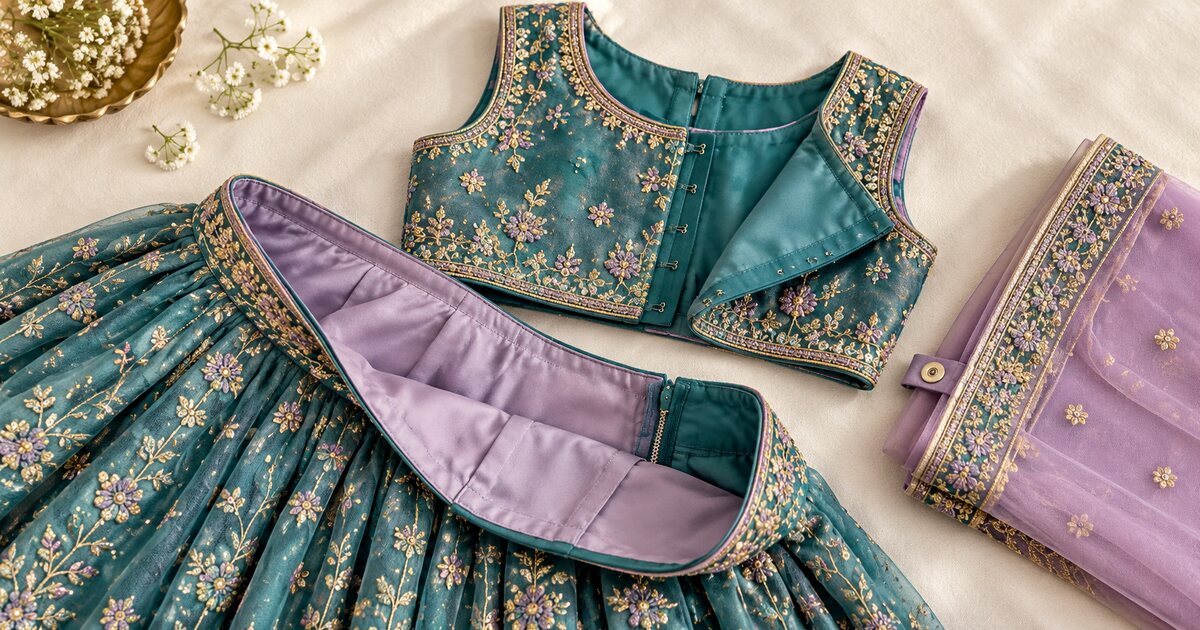
Girls’ lehenga choli buying guide
Buying a Lehenga Choli for Girls: Lining, Closures and Dupatta
The most useful details are often hidden beneath the embroidery. Learn how to inspect the lining, backing, fastenings and dupatta arrangement before accepting a girls’ lehenga choli.
A lehenga set can look polished in a front photograph while still hiding scratchy threadwork, a twisted lining or a weak hook behind the decoration. Colour and ornament matter, but they do not explain how the garment was assembled. A construction check gives you evidence that a product image cannot provide.
This guide focuses only on the physical build of the lehenga, choli and dupatta. It does not select a size, estimate garment length or replace the seller’s product information.
Inspect the set in a fixed order
Separate the pieces before judging them. A heavily decorated choli may use a different base fabric, lining and care method from the skirt. The dupatta may also have trims or attachments that need their own check. Keeping the pieces separate prevents one attractive feature from distracting you from a problem elsewhere.
- 01Read the labels
- 02View every inside surface
- 03Operate each closure
- 04Review the dupatta setup
Start with the fibre and care information supplied by the seller. Fibre names such as polyester, cotton or viscose describe composition, not softness, weight or quality. Where the outer fabric and lining have different compositions, ask which label applies to each component. Then place each piece on a clean, flat surface in good light and inspect both sides without pulling on delicate decoration.
Check what the lining actually covers
“Lined” can mean several different things. A skirt may be lined from waistband to hem, only through its upper section, or with a separate inner layer. A choli may have a full lining, a front panel only or small backing patches beneath embroidery. Ask for the exact coverage instead of relying on the word alone.
Skirt lining
Lay the skirt flat and smooth the lining independently from the outer layer. Look for twisted joins, trapped folds, puckering near the waistband and an inner layer that drags the outer fabric to one side.
Choli lining
Inspect the neckline, arm openings, side seams and closure area. The lining should sit inside the garment rather than rolling outward, and seam allowances should not form hard, bulky ridges beneath decoration.
A lining does not need to match the outer fabric exactly, but its purpose should be clear. It may reduce transparency, keep rough threadwork away from the wearer or help a lightweight outer layer hold its shape. If the lining is extremely stiff while the outer layer is fluid, or much smaller than the layer it supports, ask how the two behave after cleaning.
Look behind embroidery, sequins and beads
Decorative work can be stitched directly through the garment, supported by an additional backing, or applied as a separate embellished panel. None of these methods is automatically better. The important question is whether the chosen method leaves the garment stable and the reverse side controlled.
| Inside view | What to examine | Question for the seller |
|---|---|---|
| Threadwork exposed | Long floats, loose knots, sharp ends and threads that can catch on another layer. | Is a soft inner panel intended to cover this area? |
| Backing layer present | Edges lifting away, excessive stiffness, adhesive residue or a patch that does not cover the full decorated area. | Is the backing meant to remain after cleaning? |
| Beads or stones attached | Missing pieces, cracked beads, exposed wire or repeated loose attachments. | Are spare embellishments supplied, and what care method is recommended? |
Do not perform a forceful pull test on merchandise. Instead, support the fabric near the decoration and look for visible movement, widened needle holes or a section already lifting. One loose element may be repairable; repeated looseness across a panel suggests a broader attachment problem that deserves a clear answer before purchase.
Operate every choli closure
A closure should open and close through its complete working range without needing the embroidery to be pulled aside. Check zips, hooks, eyes, buttons, loops, snaps and ties individually. Decorative buttons may not be functional, so confirm which part actually opens the garment.
Zips
Look at both ends of the zip and the stitching beside its tape. The slider should move without catching lining, loose thread or trim. At the top, check whether the fastening has a fabric guard or another finish that keeps hard components from sitting directly against the wearer.
Hooks, eyes and snaps
Each part should sit flat and be attached through stable fabric rather than a fragile mesh edge. Check for a small reinforcement layer beneath heavily used points. A hook hidden under trim should still be reachable without bending the decoration every time the garment is opened.
Buttons, loops and ties
Confirm that loops are firmly anchored and large enough for their intended button. If ties are functional, inspect where they enter the seam and whether their ends are finished. Long cords, tassels and ties require particular judgment around children: the U.S. Consumer Product Safety Commission’s rule is specifically for children’s upper outerwear, not lehenga choli, but its documented snagging hazard is a useful reminder to consider loose cords during active play and travel.
Treat the dupatta as a separate component
Review the dupatta fabric, border and attachment method on their own. Check whether the border causes the centre to twist, whether trims are securely joined at corners and whether unfinished threads are hidden or controlled. A very heavy border on a delicate centre fabric deserves closer inspection because the join carries the difference in weight.
Some children’s sets include stitched shoulder loops, hidden snaps, small hooks or detachable tabs. Ask the seller to show exactly where every attachment connects. It should not require a sharp pin through delicate fabric, and it should be removable without tearing the dupatta or the choli. If a pin is supplied, the adult supervising the child should decide whether that method suits the occasion and activity.
Ask for these photographs when buying online
A request for “more pictures” often produces another styled front view. Name the locations you need so the seller can provide evidence relevant to construction.
- Inside of the choli: neckline, arm opening, side seam and the complete closure area in one clear view.
- Reverse of the main embroidery: close enough to show thread ends, backing coverage and bead attachments.
- Inside of the skirt: waistband join, lining attachment and lower edge of the lining.
- Dupatta corners and attachments: borders, loops, snaps, hooks or tabs shown from both sides.
- All labels together: fibre composition, care information and any separate label for the lining or decorative components.
Save the listing description and the seller’s replies until the order has been checked. When the set arrives, inspect it before removing labels, washing, steaming, pinning or altering it. If something differs from the description, photograph the issue and follow the stated return process.
Lehenga choli construction checklist
Use this list in a shop or during an indoor inspection after delivery.
Common questions
Does a girls’ lehenga need a full lining?
Not every design requires the same coverage. The useful question is whether the lining performs its intended job without twisting, showing unexpectedly or distorting the outer fabric. Ask which sections are lined and why when the listing only says “lined.”
Is visible embroidery backing always a defect?
No. Backing may support stitching or stabilise a decorated panel. Inspect whether it is intended to remain, whether its edges are secure and whether it covers the relevant work. Lifting adhesive, hard exposed edges or incomplete coverage should be clarified with the seller.
Are hooks better than a zip on a choli?
Neither is automatically better. A zip should move cleanly and avoid catching nearby fabric, while hooks and eyes should be reachable, aligned and secured through stable layers. Judge the execution of the actual fastening rather than choosing by name alone.
How should a child’s dupatta attach?
The method should be clear, removable and suitable for the planned activity. Stitched loops, snaps or detachable tabs can reduce reliance on sharp pins, but each attachment still needs secure stitching and adult judgment. Avoid tight neck arrangements and long loose sections that may catch.
What should I do when the seller cannot provide inside photographs?
Ask for a written description of lining coverage, closure type, embroidery backing and dupatta attachments, then review the return conditions before ordering. A styled front image cannot confirm hidden construction, so treat missing evidence as an unresolved buying question.
Sources and standards consulted
- International Organization for Standardization, ISO 4915:1991 — Textiles: Stitch types, classification and terminology. Accessed October 18, 2026.
- International Organization for Standardization, ISO 4916:1991 — Textiles: Seam types, classification and terminology. Accessed October 18, 2026.
- UK Department for Business and Trade, Textile labelling guidance. Accessed October 18, 2026.
- U.S. Consumer Product Safety Commission, Drawstrings in Children’s Upper Outerwear. Accessed October 18, 2026. The cited rule concerns upper outerwear; this article does not present it as a lehenga-specific legal requirement.
Content review date: October 18, 2026.