
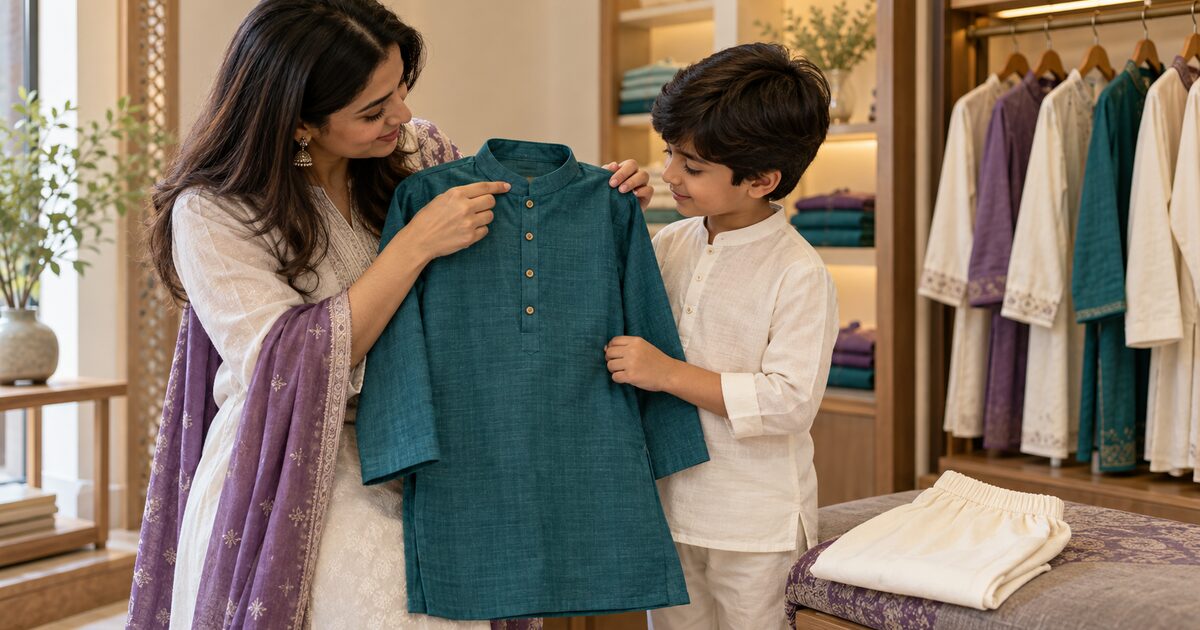
Kurta pajama buying guide
Choosing a Kurta Pajama for a Child: Cut, Closures and Fabric
Look past the surface design. A practical set should suit the occasion, open easily for dressing, feel smooth on the inside and use a pajama waistband your child can manage.
Product photographs often show colour and embroidery clearly but reveal little about the parts that affect daily use. Before comparing designs, decide what the outfit must do. A set for a short family photograph has different demands from one expected to last through school, travel, meals or active play.
- Define the occasion and expected wear time.
- Choose a cut and opening the child can use.
- Inspect inside finish and waistband design.
- Confirm care instructions and seller policy.
Choose the kurta cut by use, not appearance alone
“Kurta” describes a broad group of tops rather than one fixed shape. Two garments can look similar from the front but behave differently because of the side seams, flare, armholes, hem shape or added layer. Use the product photographs to study the silhouette from the front, side and back.
Simple and versatile
A straight kurta keeps a consistent line through the body. Check that side slits are reinforced and begin at a sensible point for sitting and walking. A narrow-looking body is not automatically restrictive, but it should not depend on deep side openings to create all the movement room.
More room through the lower section
A flared cut can feel less confined around the lower body and gives a dressier shape. Check the extra fabric when the child sits or climbs stairs. Heavy borders and layered hems can make a roomy silhouette feel cumbersome even when the body is not close-fitting.
Easier for active everyday wear
A shorter style may be convenient for play, travel or frequent sitting. Inspect the back view and side openings so the top continues to cover as intended during movement. Do not assume the same labelled style will have an identical shape across sellers.
Check every layer separately
A waistcoat or jacket changes how the shoulder and arm area works. Confirm that the under-kurta remains usable on its own, the top layer closes without pulling, and decorative fronts do not make bending or sitting awkward.
For online purchases, ask for an unposed side or back image if the listing only shows the front. This can reveal whether the kurta has side slits, a centre opening, a shaped hem or a back fastening.
Inspect the collar and opening together
A neckline can look comfortable while still being difficult to pull over the head. Judge the collar, opening depth and fastening as one system. The best option is the one the child can wear without the neckline scraping the face, buttons taking excessive force or an adult repeatedly correcting the closure.
Collarless or round neck
This can be straightforward for everyday dressing when the opening is generous or supported by a placket. Check the inside facing: it should lie flat rather than folding outward or rubbing at the neck.
Band collar
A band collar gives a formal finish. Look at the closed position, not only photographs where the top button is left open. The collar edge, label and seam allowance should feel smooth, and the child should be able to turn their head normally.
Button placket
Buttons allow the neck opening to expand for dressing. Check that buttonholes are neatly finished, spare threads are removed and buttons are firmly attached. Decorative buttons may hide snaps, so ask which parts actually open.
Zip, snap or hook-and-loop opening
These can speed up dressing, especially on the back or shoulder. Inspect whether the fastening has an inside guard, whether the top edge touches the skin, and whether hook-and-loop tape can catch embroidery or another delicate part of the set.
Useful photo request: ask the seller for one image of the opening fully undone and one image of the inside neckline. Those two views often answer more practical questions than another styled front photograph.
Pick a pajama waistband the child can manage
Waistband design affects dressing, washroom independence and how often the pajama needs adjustment. Ask whether a visible cord is functional or decorative, and whether the elastic runs around the full waist or only part of it.
Quick pull-on dressing
This is often the simplest everyday option. Check that the elastic is enclosed smoothly, does not twist inside the channel and can be replaced or adjusted if the garment is intended for repeated use.
Adjustment with an extra step
A working drawcord can fine-tune the waist, but the child must be able to tie and untie it reliably. Confirm that the pajama stays up on the elastic alone and that the cord ends are short, secure and free from bulky ornaments.
Formal front with flexible back
This design can look more tailored while retaining some flexibility. Check the join between the flat and gathered sections and make sure any front fastening is easy for the child to operate.
Structured but less forgiving
A fixed closure may suit older children or a formal style. Test the complete opening sequence, including any inner button or hook, rather than assuming the visible button does all the work.
Choose fabric by feel, finish and care
Fibre name alone does not tell you how a finished outfit will feel. Weave, fabric weight, lining, embroidery, printing and finishing treatments all matter. Read the fibre and care labels, then inspect the parts that touch the skin.
Cotton and cotton-rich fabric
Often considered for regular or warm-weather use, but quality varies widely. Check softness, opacity, stiffness, seam finish and the actual washing instruction. Ask whether the finished outfit—not only the base cloth—was tested for the care method shown on the label.
Linen and linen blends
These can produce a textured, relaxed appearance. Decide whether visible creasing suits the occasion, and inspect rough seams or firm decorative borders. A blend may behave differently from pure linen, so use the garment label rather than the product name alone.
Viscose, rayon and flowing blends
These are often selected for softer drape. Check whether the fabric becomes clingy, whether embroidery makes it sag, and whether the care label requires gentle washing, flat drying or another method that fits your routine.
Silk-look, brocade and occasion fabrics
Formal surfaces can include metallic yarn, firm borders or dense embellishment. Inspect the lining coverage, underside of embroidery and seam bulk. Confirm cleaning instructions before buying, especially when the kurta and pajama use different materials.
Inside-construction inspection map
Turn the garment inside out or request clear close-up photographs of these points.
Care instructions deserve the same attention as colour and design. A multi-piece set may use different fabrics or decorations, and one care method may not suit every component. The Bureau of Indian Standards lists a current textile care-labelling code using symbols, while the U.S. Federal Trade Commission explains that care instructions should cover the finished garment and its components. Requirements differ by market, but the practical lesson is universal: read the label before committing to a cleaning routine.
Questions to ask the retailer before ordering
Use this list when the product page does not show enough construction detail. Save the seller’s answer with the order confirmation in case the delivered set differs from the description.
- Is the kurta straight, flared or layered, and are there side slits?
- Which neckline parts open, and are the visible buttons functional?
- Is the embroidery backed or lined where it touches the skin?
- What is the fibre content of the kurta, pajama, lining and decorative layer?
- Does the pajama use full elastic, partial elastic, a working drawcord or a fixed closure?
- Can the child use the pajama closure without adult help?
- Are tassels, beads or other ornaments stitched or glued?
- Do both pieces follow the same washing and ironing instructions?
- Can the kurta and pajama be exchanged separately if only one piece is unsuitable?
- Does the return policy allow a careful indoor try-on before tags are removed?
Avoid relying on “premium,” “soft,” “summer fabric” or “easy care” without supporting details. Ask for the fibre label, care label and close-up images that make the claim useful.
Common questions
Which kurta pajama fabric is best for everyday wear?
There is no single best fibre for every child or climate. For frequent wear, prioritize a surface the child accepts, straightforward care instructions, durable seam finishing and minimal decoration in high-friction areas. Evaluate the finished garment rather than choosing from fibre name alone.
Is a collarless kurta always more comfortable?
No. A collarless neckline can still have a narrow opening, stiff facing or scratchy label. A well-finished band collar may feel comfortable when it closes without pressure and the inside edge is smooth. Inspect the construction, not only the collar category.
Is elastic better than a drawstring for a child’s pajama?
Full elastic is usually quicker to manage. A functional drawcord can add adjustment, but it also requires reliable tying and untying. The better option depends on the child’s independence, the security of the elastic and how the cord is finished.
How can I assess embroidered clothing online?
Request close-ups of the embroidery front, its underside and any lining. Ask whether ornaments are stitched or glued and whether dense work touches the neck, underarm or waistband. Product photographs taken only from a distance cannot answer these questions.
Should I buy a fixed set or separate pieces?
A fixed set is convenient when both pieces suit the child and share workable care instructions. Separates provide more flexibility when the preferred kurta cut and waistband type are not offered together. Check the retailer’s exchange policy before choosing.
Sources and standards consulted
- Bureau of Indian Standards, IS 15370:2023, Textiles—Care Labelling Code Using Symbols. Retrieved on October 15, 2026.
- U.S. Federal Trade Commission, Clothes Captioning: Complying with the Care Labeling Rule. Retrieved on October 15, 2026.
- U.S. Federal Trade Commission, Threading Your Way Through Textile and Wool Labeling Requirements. Retrieved on October 15, 2026.
Review date: October 15, 2026. Legal labelling requirements vary by market; use the sources above as context and follow the rules that apply where the garment is sold.