
Practical fit guide
How to Check Whether Your Child’s Clothes Fit
A useful try-on goes beyond a quick look in the mirror. Watch what the garment does while your child sits, bends, reaches and walks, then decide whether the problem is acceptable, alterable or a reason to return it.
Fit is about how a particular garment behaves on a particular child. A label can be a useful starting point, but the final decision should come from the try-on. Use the same underlayers, footwear and fastening position your child would normally wear with the item so the test reflects real use.
Use the Look–Move–Ask try-on check
This three-part routine takes only a few minutes and makes it easier to separate a styling preference from a genuine fit problem.
- Look at the garment at rest. Fasten it normally without pulling the sides together or tightening an adjustable feature beyond its usual position. Check whether seams, waistbands, necklines and hems sit where the design intends.
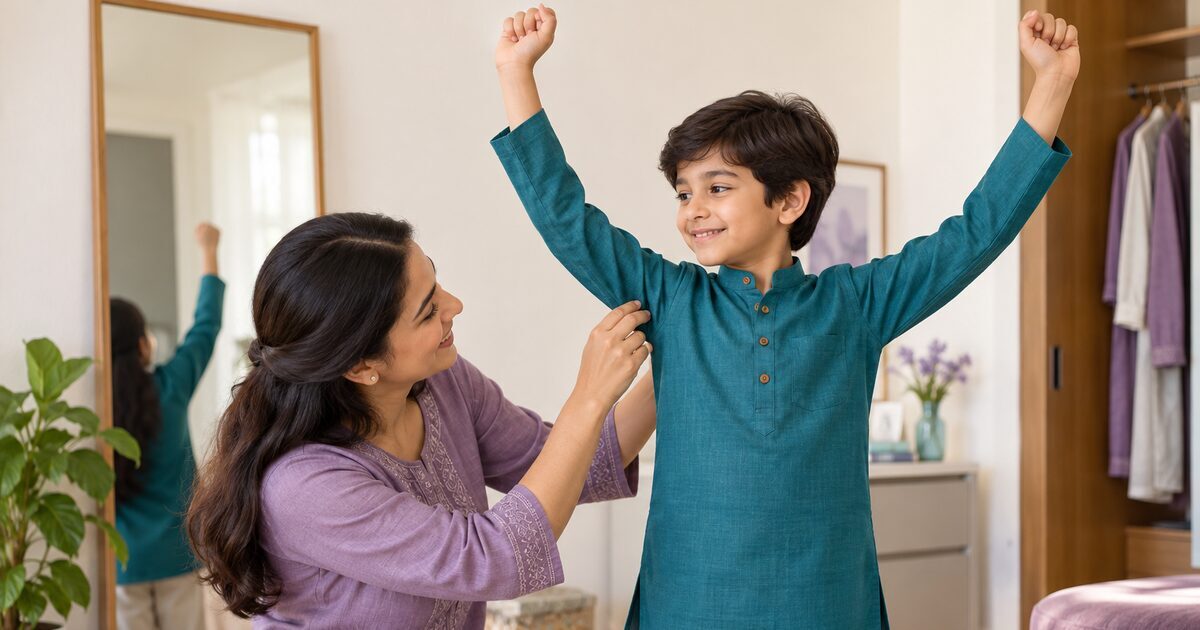
- Raise both arms. Ask your child to reach overhead and then forward. Watch for a top that stays bunched up, a neckline that pulls backward, cuffs that stop the movement or a hem that exposes more than expected.
- Sit and bend naturally. Use a chair, the floor or a comfortable squat. Look for a waistband that rolls, a back hem that drops too far, fabric that pulls sharply across the seat, or a rise that feels restrictive.
- Walk and take a step up. A few normal steps reveal twisting side seams, slipping shoulders, a dragging hem and trouser legs that catch under the feet. For a coat, close it first and test it over the usual layers.
- Ask, then observe. Ask where the item pinches, rubs, scratches or feels heavy. With a younger child, watch for repeated tugging, avoiding a movement, pulling at the neckline or trying to remove the item.
Do not judge from one wrinkle. Fabric type, pleats and the intended silhouette all affect appearance. A stronger warning is a sign that returns in several movements, changes how the child moves or needs constant readjustment.
Read the fit signals by area
Neck and shoulders
A neckline that presses, shifts backward or pulls to one side needs attention. Shoulder seams that climb toward the neck can indicate restriction; seams that drop far down the arm may make sleeves and armholes sit poorly. Decorative wide or dropped shoulders are an exception, so compare the behaviour with the garment’s intended shape.
Chest, back and armholes
Watch for buttons that gape, a zip that buckles under strain, strong horizontal pull lines or armholes that press when the arms move. On the other hand, a neckline or armhole that opens widely, exposes an underlayer or repeatedly falls out of place may be too loose for the design.
Waist, seat and rise
The waistband should stay in its intended position without rolling, digging or sliding. During sitting and squatting, check for pockets that flare, fabric that pulls tightly across the seat, or trousers that are dragged down at the back. A loose waist is still a problem if tightening it creates bunching or discomfort elsewhere.
Sleeves, cuffs and hems
Sleeves should allow the elbows to bend and the hands to work freely. Trouser and skirt hems should clear the floor during walking and stairs. Extra length is not useful growth room if it covers the hands, catches under shoes or must be held up during play.
Adjust the check for the garment
Shirts, T-shirts and kurtas
Test reaching, crossing the arms and sitting. Check that the shoulder and upper back do not restrict movement, front openings stay flat, and the hem does not remain caught above the waist after the arms come down.
Trousers, jeans and shalwar
Use sitting, squatting and a step-up. The child should not need to widen their stance, hold the waistband or shorten a normal step. Check the waist, seat, knees and ankle opening as separate areas rather than blaming every issue on the waistband.
Dresses, frocks and lehenga sets
Test the bodice and skirt separately. The bodice should allow the arms and torso to move without gaping or pulling; the skirt should allow sitting and walking without being stepped on. For a two-piece outfit, one piece can fit even when the other does not.
Coats and layered outfits
Try outerwear over the layer it will cover, close every fastening and repeat the arm movements. A coat can look roomy while still restricting the shoulders. Also check that hoods, collars and accessories do not block normal vision or movement.
Do a separate safety check
Comfort and safety overlap, but they are not the same test. Inspect damaged fasteners, loose decorations, cords and anything that can catch during normal use. Stop using an item if a broken component creates an immediate hazard, and check the manufacturer’s instructions or recall information when relevant.
Sleepwear is an important exception
Do not automatically reject children’s sleepwear simply because it is labelled to fit snugly, and do not size it up just to make it loose. In the United States, certain children’s sleepwear is specifically designed and labelled as tight-fitting under federal flammability requirements. Follow the garment label and the rules that apply where the item is sold.
Check outerwear drawstrings
For U.S.-market children’s upper outerwear, the Consumer Product Safety Commission identifies hood and neck drawstrings in sizes 2T through 12 as a substantial product hazard. Waist and bottom drawstrings in sizes 2T through 16 are also subject to restrictions. This is a product-safety issue, not something a successful movement test can override.
These examples describe U.S. requirements. If you are elsewhere, check the garment label and your local product-safety authority; rules and size ranges can differ by market.
Keep, alter or return?
Make the decision after the full movement check, not after fixing the item in place for a photograph. For sets, decide on each piece separately.
Keep
Keep it when the child can move normally, the garment settles back into place, closures stay secure and there is no repeated pulling, slipping or complaint during the try-on.
Alter
Consider alteration when the overall fit works and the issue is local, such as an unfinished hem or adjustable strap. Confirm that the change will not distort the garment, weaken a closure or interfere with a safety feature.
Return or exchange
Return it when movement is restricted, several areas fit poorly, a fastening remains under strain, a hem creates a trip risk, or the child cannot wear it without constant adjustment. Structural problems at the shoulders, rise or bodice are rarely solved by a simple hem.
Final fit-check list
- Try the item with its normal underlayers and footwear.
- Close fastenings without forcing or over-tightening.
- Raise the arms, reach forward and cross the arms.
- Sit, bend, squat, walk and take a step up.
- Check whether fabric settles back after movement.
- Look for persistent strain, slipping or twisting.
- Ask about pinching, rubbing and scratchy areas.
- Check hems, cords, closures and loose components.
- Judge both pieces of a set independently.
- Respect sleepwear labels and local safety guidance.
Common questions
Is standing in front of a mirror enough to check fit?
No. A garment can appear neat while the child is still but pull, slip or restrict them when they sit and reach. Include the movements the child will actually make while wearing it.
Should children’s clothes always have extra room to grow?
Some room can be practical, but only when the garment still stays in place and does not cover the hands, fall from the shoulders or catch under the feet. Oversized clothing is not automatically a better fit.
Can a tailor fix any poor fit?
Simple length or strap adjustments may be practical. A mismatch through several structural areas—such as the shoulders, armholes, bodice or trouser rise—usually needs more extensive work and may not be worth altering. Ask a qualified tailor before removing tags or passing a return deadline.
What if only one piece of an outfit fits?
Judge each piece on its own. If the retailer allows separates or exchanges, replace only the problem piece; otherwise base the decision on whether the complete outfit can be worn comfortably and safely as intended.
Safety sources
- U.S. Consumer Product Safety Commission, Drawstrings in Children’s Upper Outerwear. Accessed 15 October 2026.
- U.S. Consumer Product Safety Commission, Infant Garments and Tight-fitting Sleepwear Garments. Accessed 15 October 2026.
Last reviewed: 15 October 2026. This guide provides a practical clothing check and general safety context; it does not replace product labels, recall notices or local regulations.